
What the letter is for
A letter of explanation for an eviction is a one-page note that travels with your application and states the facts behind the record. It doesn’t change a screening score.
It supports a manual review at buildings whose written criteria allow one. It also answers the leasing office’s first question before they ask it.
The timing matters. Under the Fair Credit Reporting Act, screening companies can report an eviction record for up to seven years, generally counted from the judgment date. An older eviction can still show up on a report, so a short, factual note is worth having ready.
The eviction hub explains when a manual review is available, and the recent vs. older eviction guide covers how the age of the record changes your options. This guide gives you the template for your apartment application.
The five sections
Use these five sections, in this order, and keep the whole letter to one page:
- Header. Your name, the date, the property you are applying to.
- The item. The case number, the court, the filing date, the outcome.
- The resolution. What happened to any balance, with dates and amounts.
- Current status. Your income, your current housing, and on-time rent since.
- Attachments. A list of what is enclosed.
The template
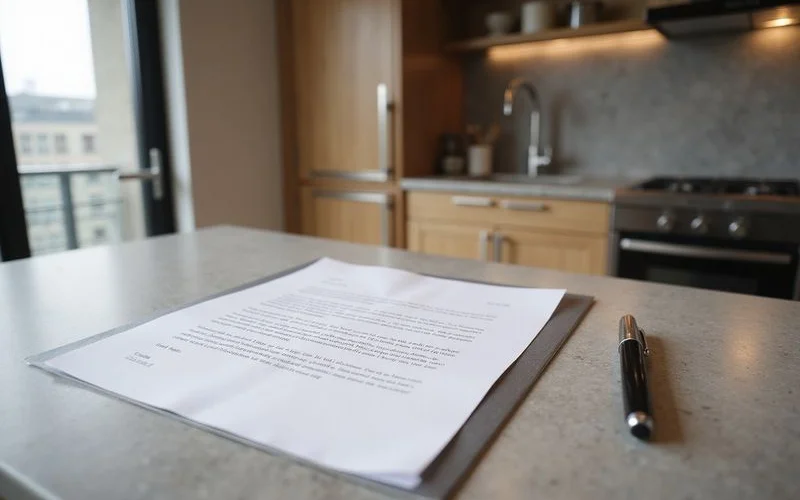
Copy this and swap in your details. In Texas, eviction suits are filed in the justice court of the precinct where the property sits, so the court name in your letter should match your paperwork exactly.
Letter of Explanation
[Your name] | [Date] | Application for [property name], unit [number]
Item: Eviction suit, [Precinct] Justice Court, [County] County, case no. [number], filed [date]. Outcome: [judgment for possession entered (date) / dismissed (date)].
Resolution: Balance of $[amount] owed to [past property] paid in full on [date]. Zero-balance letter attached. [Or: Release of judgment filed (date).]
Current status: Employed at [employer] since [month, year], gross monthly income $[amount]. Renting at [current address] since [month, year], with on-time payments.
Attachments: Court disposition; zero-balance letter; last two months of paystubs.
[Signature] | [Phone] | [Email]
What to leave out
Leave out anything a leasing office can’t verify or doesn’t need. That means four things:
- The story. Reasons, conflicts with the past landlord, and personal hardship do not change the screening result. Facts do.
- Blame. A building reads blame as a risk signal.
- Promises. “This will never happen again” carries no weight against a ledger.
- Health, family, or other personal details. They are not part of the screening and you do not owe them to anyone.
Discretion works in your favor. “A 2019 eviction, balance paid” says everything a building needs.
Attach proof for every claim
Every line in the letter needs a document behind it. A claim without paper is just a claim, and a manager reviewing a file has no reason to take your word for it.
| Claim in the letter | Document |
|---|---|
| Case outcome | Certified disposition or dismissal order from the justice court |
| Balance paid | Zero-balance letter or release of judgment |
| Income | Paystubs or a signed offer letter |
| On-time rent since | Rent ledger or a letter from your current landlord |
One more tip from our desk. If a building denies you based on a screening report, it must send an adverse action notice that names the screening company and explains your right to dispute errors. If the report has a mistake, such as a dismissed case listed as a judgment, attach the corrected record to your next letter.

Where it goes in the packet
The letter goes last, after ID, income proof, and the flag documents. The full order sits in the application packet guide.
Putting it at the end means the reader sees your documents first and then gets the short explanation that ties them together.
When it helps and when it does not
It helps at buildings with a manual review step and at smaller properties where a manager reads the file. It does not help at a building whose written criteria deny your eviction’s status or age outright.
We read the criteria first, so your letter only goes where it can be read. Do the same before you apply: find the property’s written screening criteria, check for a manual review step, and send the letter only if one exists.